


3. The Laws of the Strands
- Peter Chaff
- Jan 17, 2021
- 4 min read
Updated: Mar 29, 2021

Far beyond the puzzle of our worlds, yet sewn into the fabric of them all, is Geneva Farewell. She is a direct descendant of the purest human archetypes. Her introductory fanfare is played on page 3 of John Levesque's version of the imaginary novel by me, Peter Chaff. In my imagination her fanfare was not something from Mahler's seventh symphony, it was a reunion song that was popular among the volunteer worker brigades of Sirius.
No author of fiction can avoid choices that alter the ecology of all the pages that come before and after. By ecology I also mean operating system. By operating system I also mean the multiverse.
One word on one page can alter an entire book. This is why an author must not load the front end of her truck's trailer with weight that's meant to be shared by the rear axles. (I am a technical writer in Samla Bishap's version of Geneva Farewell, hence the load security metaphor. Unfortunately, SB's book is not available in your world, and only small channels of it seep into me. I hope to capture some of her flawed but intriguing conception in future posts.)
Geneva Farewell is introduced twice in JL's book, first on page 3 with the Mahler horn fanfare, then again on page 14 ("Now, from the far side of the room I followed the progress of a woman...") The return of a memory rightly comes before the narration of our actual meeting, but each of them is unreliable. What's much more reliable is the process that enables them to interact in the mind. This is the Law of the Strands.
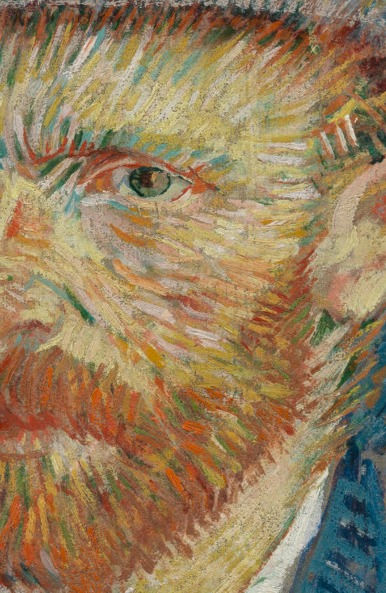
The image of Geneva Farewell on the cover of JL's book, partly shown above, is a graphic artist's impression of her, perhaps based on a one-page summary of her "story" that was provided by the publisher. The image is pointillistic or pixellated, like Salvador Dalí 's masterpiece, Gala Contemplating the Mediterranean Sea which at Twenty Meters Becomes the Portrait of Abraham Lincoln - Homage to Rothko (Second Version). The closer you get to some things, the less you see. That's another Law.

The title of every one of Dalí's works in JL's novel is Dalí's own. (See pages 12 and 14 through 17.) Using Dali in this way garnishes Geneva's high regard for surrealism. ("She was wired for men the same way she was wired for tobacco and surrealism," page 54.)
Even the purest archetype, a Protector like Geneva Farewell, is subject to the Laws of the Strands. Like all archetypes, her essence is forever hidden to us. If you get close enough to her you swear you can see her essence, but you can't. On page 15 of his novel, when JL has me say to her "I'm relieved to meet you," JL shows more insight into this process than I had at the time, because I really didn't know what I meant when I said it.
A Protector's DNA, gender ratio and life history are always secondary to their archetypal role as shields from a Catalyst's turbulence. The image of the woman on the cover of JL's book is that of a Protector. But her avatar is associated with a very rare group of Unconscious Protectors who have no notion of what their mission is. (Page 14 of JL's version: "I nodded meaningfully at her, as though to confirm whatever she suspected had just come true -- her fondest wish or deepest fear...")
Rudy Monteverdi is the one who informed me that I am a Catalyst. Many people with a zealous imagination are Catalysts whether they know it or not. Zealous imaginers cause uncontrolled eruptions in their strands which also produce turbulence in other strands. A Catalyst behaves this way because it is what a Catalyst is born to do.
Every Catalyst needs a Protector at some point in their life. They might even need a Translator like Rudy Monteverdi, as I did and still do. (Beware of pseudo-translators like Rosamund St. George, MD, who is introduced on page 4 of Geneva Farewell. Even with the best intentions, demi-archetypes inevitably bring their own turbulence to the table.)
Archetypes have tremendous freedom of movement compared to those who live only in their own flesh. The purest among them, non-hybrids like Geneva Farewell, are everywhere in one guise or another. But they are subject to the whims of turbulence just like the rest of us. You can believe Rudy Monteverdi when he says on page 199 of JL's book, "The cosmos is a lawless zone of fugitive patterns. To claim that we understand the purpose or meaning of any of these patterns is to stray far above our station in life as tool-making creatures."
Monteverdi also said, strangely unrecorded in either print version of my imaginary novel despite its pithy rendering of a major theme: "The self is too much for any one person to manage."
For a few short weeks, Geneva Farewell managed my self and I managed hers. We altered the ecology of each other's imagination. Her belief in me was incomplete and so was mine in her. Our love took root in that sublime incompleteness. Asking who is Geneva Farewell is as unanswerable now as it was when Geneva asked herself on page 129 of JL's book:
"You seem to think I'm perfect, well I'm not. I have weaknesses like everyone, maybe more than most, it's always been the hardest thing in the world for me to admit to you or anyone else that I seem to be losing all sense of myself, the outer shell may be fine but the inside is hollowing out."
Geneva Farewell is an Unconscious Protector and was bound to lose herself in that role. My role as an impure Catalyst is to continue to be unworthy of her.


Comments