


10. A reader writes:
Updated: Sep 11, 2022
Dear Peter Chaff, I have read a few of your posts, in no particular order. Your most urgent problem, it seems to me, is to find a way out of your metaphysical ass. If you don't act fast you will smother in the lower intestines of ontology (the study of thought) and epistemology (the study of knowledge). These "disciplines" are not productive or even wholesome areas of study. They should be off-limits to the public, as they undoubtedly are in your more authoritarian Roman Capitalist world.
Having said that, I did read a handful of your posts and I thought I might at least try to correct some of your more fundamental errors. The fact that I am confessing some reservations about reaching out to you attests, I hope, to my sincerity and good will. You are a misguided person and if I can help you sort through your confusion, we will both grow from the experience.
Dear reader: I number the posts in the vain hope that readers will start at post number 1 and read them in sequence.
Dear Peter Chaff: Students of ontology ask, "What do we mean when we say 'meaning'?" Students of epistemology ask, "Is it possible to know anything?"
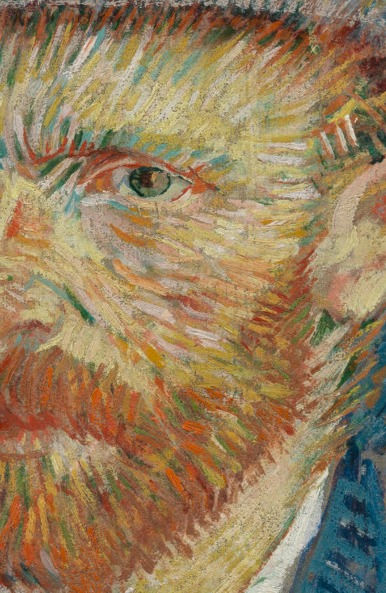
These are the kind of unanswerable-irrelevant questions that have given philosophy, art and religion a bad name. No one bought the paintings of van Gogh in his lifetime because they bypassed all questions and allowed beauty and deformity to infuse one another with great power. Professional and amateur consumers of art in his day wished his paintings could all be stored away in deep caves where archaeologists might find them one day in in the far future. Their deeper hope, of course, was that his works would fade naturally from the history of art. The Gnostic Underground made sure that didn't happen. Look at him in this self-portrait: He understood what he was up against and stayed resolute as long as he could, birthing universes with each stroke of his brush.
What do we mean when we say art? How do we know if something is worth knowing? Perhaps if we forgot such questions they would go away. But they don't, Peter Chaff. They go underground, where human intuition, steeped in eons of development, waits patiently for the centuries-long inflammation of the intellect to subside. This underground environment is the seedbed of our deepest wisdom, the fountainhead of all that we--
Dear reader: You have taken over this post.
A reader writes: --the fountainhead of all that we hold dear in the deepest or "least assimilated" part of ourselves, as Monteverdi puts in on page 15 of John Levesque's version of Geneva Farewell.
OK, I'll stop now, your discomfort is evident. I have one request of you at this time. Listen carefully:
If I understand your Post 7 correctly, an Agent of Mass Reaction is a Catalyst whose opinions or emotions coincide with those of a great number of other humans, or whose life situation rouses a great number of other humans to action that inspires new followers. Would you agree if I said that Vincent van Gogh turned into an Agent of Mass Reaction after he died?
Dear reader: That's how culture in general works. A work of art is considered classic if it--
A reader writes: Please think about that question, Peter Chaff as you fulfil my request. I want you to compile a list of prominent Agents of Mass Reaction, dead or alive, in the world of Geneva Farewell. This will help your readers better understand who or what might be an Agent of Mass Reaction in our own world.
Although we come from different reality strands, we live in the same barbarian civilization. We are the descendants of the warrior peoples of northern Europe who built their culture from the wreckage of the Roman Empire. We have a short attention span and a long list of grievances. We would do well to understand the forces that have taken us down this road.
Please don't think that by requesting a list of Agents of Mass Reaction I fully endorse your map of human nature, the Catalysts, Translators, Protectors, etc. But let's start with my requested list and see if we can put it to some use.
That's enough for now, Peter Chaff. As you were.


Comments